CETEF’26: Europe must fight for its technological future
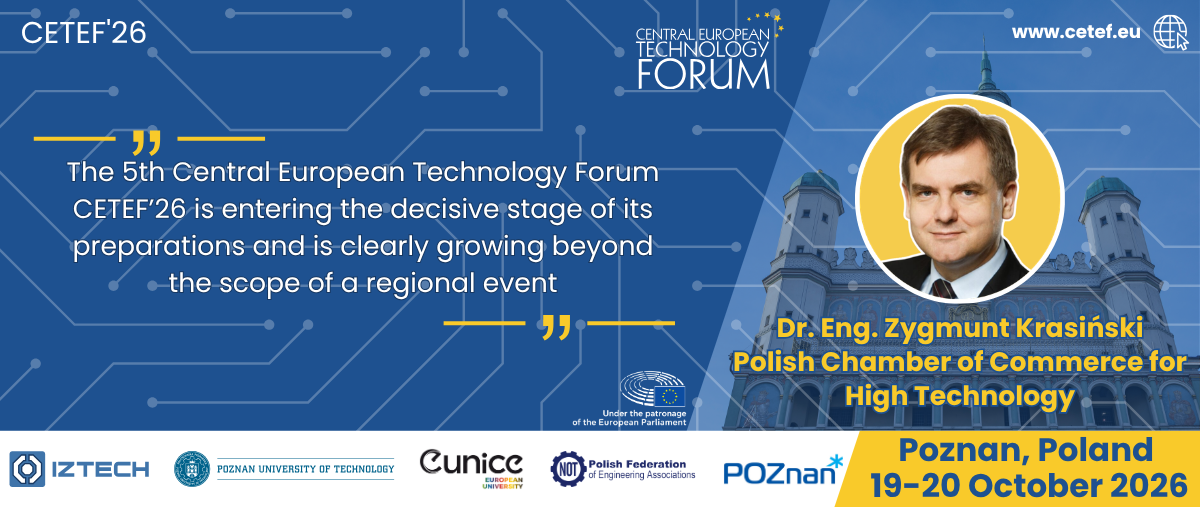
The 5th Central European Technology Forum CETEF’26 is entering the decisive stage of its preparations and is clearly growing beyond the scope of a regional event. Partners from France, Germany and the United States, as well as representatives of European institutions, academia, industry and public administration, are joining the initiative. In Poznań, the discussion will focus not only on new technologies, but above all on how to harness them to strengthen Europe’s security, competitiveness and sovereignty. I spoke with Dr. Eng. Zygmunt Krasiński, President of the Polish Chamber of Commerce for High Technologies (IZTECH), about the Forum’s growing importance, Poland’s position in the European technology race, and the lasting outcomes that CETEF’26 is expected to deliver long after the event concludes.
When we spoke in May, CETEF’26 was still in the phase of intensive preparations. What has changed the most?
Above all, it is clear how significantly the importance of the Forum has grown at the European level. CETEF is not merely a discussion among experts, managers, technology companies, and research institutions. It is also a debate on Europe’s technological development strategies and the instruments designed to support that growth.
We are at a unique juncture. One financial framework is coming to an end, the final calls for proposals in national programs and Horizon Europe are launching, and at the same time, discussions about the next framework are underway. We are counting on the participation of, among others, Henna Virkkunen, Executive Vice-President of the European Commission for Tech Sovereignty, Security and Democracy, and Borys Budka, Chair of the European Parliament’s Committee on Industry, Research and Energy (ITRE).
Equally important is linking the European dialogue with what is happening in Poland—with strategies regarding artificial intelligence, cybersecurity, quantum technologies, photonics, and semiconductors. We work closely with the Ministry of Digital Affairs—the Strategic Institutional Partner of CETEF’26—as well as the Polish Agency for Enterprise Development (PARP) and the National Centre for Research and Development (NCBR). All these elements are beginning to connect: the national, regional, and European levels.
CETEF has previously been strongly associated with Central Europe. Meanwhile, France and Germany, as well as partners from the US, are actively getting involved. Is the Forum expanding beyond its original regional scope?
For me, this is one of the most exciting shifts. The interest from our partners has exceeded my expectations. We are showcasing the potential of our region, but at the same time, we are vigorously expanding cooperation across a wider European framework. Strong partners from France and Germany are coming forward—in a sense, you could say we are technologically rebuilding the concept of the Weimar Triangle.
However, we are not limiting ourselves solely to Europe, because technologies have a global dimension. For years, we have been developing cooperation with US organizations whose representatives will also be in Poznań, encouraging joint applications for ambitious projects funded by American agencies.
Central Europe must demonstrate its competencies while collaborating with the strongest hubs in Western Europe. France and Germany possess vast experience in delivering large-scale European projects. We offer scientific, engineering, and industrial potential. Combining these capabilities opens up entirely new possibilities.
What enabled an event initiated by IZTECH to achieve such standing?
From the outset, the authority of Prof. Jerzy Buzek—who chairs the Council of the Polish Chamber of Commerce for High Technology (IZTECH) and is closely associated with CETEF—has been of paramount importance. His European experience, including his tenure as President of the European Parliament, allowed us from the very first edition to build the Forum not as a local event, but as a venue for genuine European debate on science, industry, and technology. Professor Buzek provides substantive support, consults on the directions of future editions, and helps maintain a European perspective across the entire initiative.
Our growing reputation is also driven by the dynamism of the domestic high-tech sector. Since IZTECH’s inception, many of its founding companies have achieved tremendous international success—look, for instance, at Adamed Pharma or WB Electronics.
How many partners are behind the organization of the 5th Central European Technology Forum CETEF’26 in Poznań, alongside IZTECH?
CETEF, taking place on October 19–20 in Poznań, would not exist without its partners. Crucial contributions come from the Poznan University of Technology—the host of the Forum—as well as the Polish Federation of Engineering Associations (NOT), the European university alliance EUNICE, the City of Poznań, Adam Mickiewicz University, Poznań University of Life Sciences, the Military University of Technology, the Łukasiewicz Research Network institutes, SWPS University, and the Poznań Supercomputing and Networking Center (PCSS), alongside strategic industrial partners: ENEA, Orange, and WB Group.
Our role is to integrate and promote this potential. Poland has an abundance of outstanding companies, universities, institutes, and experts, but they often operate in silos. Someone needs to bridge these communities, and CETEF serves as precisely that platform.
What is the agenda for the two-day Forum?
The first day focuses on high-level policy discussions—debating European technology strategy, security, and development funding instruments. We aim to bring together representatives from the European Commission, the European Parliament, national public administrations, funding agencies, industry, European partnerships, and the engineering community. Following keynote addresses, we plan a high-level debate on the future trajectory of European technology policy. Rather than a series of formal speeches, we want a substantive exchange on the instruments Europe must create to effectively advance strategic technologies.
The second day belongs primarily to technologies and domain experts. Across eight conferences, we will discuss artificial intelligence, automation and robotics, quantum technologies, energy, biotechnology, cybersecurity, defense and dual-use technologies, and industrial solutions. We are not aiming for massive conferences simply for the sake of headcount. Having several dozen leading specialists in quantum technologies who genuinely have insights to share and can formulate actionable recommendations carries far greater value than an auditorium of a thousand random attendees.
The motto of CETEF’26 is “High Technologies for Europe’s Security.” Why has technological security become so critical today?
Because technology is no longer just a sector of the economy; it has become the foundation of national security. We are witnessing an intense tech race, the war in Ukraine, supply chain disruptions, and Europe’s dependence on imports for numerous critical components. Consequently, defense and dual-use technologies, cybersecurity, AI, quantum technologies, space, and energy technologies hold a completely different significance today than they did just a few years ago. Europe must regain the capacity to create its own strategic technologies and rebuild its industrial base. Without this, real sovereignty is unattainable.
You place particular emphasis on the need to re-industrialize Europe. Why?
Because without industry, there can be no technological sovereignty. For years, Europe benefited from cheap manufacturing in other parts of the world. Today we are facing the consequences: reliance on imports for electronics, microprocessors, and critical technologies. That does not mean every country needs to produce everything domestically; we need a smart division of capabilities across Europe.
Poland possesses immense intellectual potential, exceptional engineers, talented young minds, and an increasingly sophisticated research infrastructure. We must not have an inferiority complex. We have to compete for our spot in the European technology premier league, acting as active contributors to the reconstruction of European high-tech manufacturing rather than merely serving as a consumer market for foreign technologies.
Artificial intelligence will feature prominently during the Forum. Has AI become a technology that permeates every other domain?
Artificial intelligence touches practically everything. It is already a revolution spanning science, industry, management, security, and everyday life. However, it must be safe, responsible, ethically grounded, and built on high-quality data. Humans must retain control. We also need technological safeguards to audit AI systems, counter disinformation, and ensure cybersecurity. AI can be a fantastic tool, but its value depends entirely on the knowledge fed into it. This is where expert communities—like those gathered around CETEF and AI Factories—play a vital role.
Young researchers remain an important focus of the Forum. Why do you invest in them so heavily?
Because they will eventually take the reins of technological development. They need to interact with top scientists, engineers, and entrepreneurs—to observe them, debate, learn, and also showcase their own solutions. They are the future leaders. That is why we want to engage student research groups, early-career researchers, startup founders, and creators of technology demonstrators. They should not be passive spectators at CETEF, but active participants.
Beyond inspiring attendees, CETEF aims to produce concrete projects. Is that the purpose of the matchmaking sessions?
Exactly. The Industry Contact Points Network organizes professional brokerage meetings via the European B2Match platform to help participants capitalize on the final Horizon Europe calls. Attendees create competence profiles in advance, pitch their projects, and search for partners. Prior to the Forum, they can screen prospective consortium members and schedule dedicated meetings.
In Horizon Europe, a good idea alone is not enough. You need a robust international consortium, trustworthy partners, and an established standing within European networks. Central Europe must enter these consortia not as an extra, but as an equal partner.
Is integration the single most important role of IZTECH today?
Definitely. The Chamber serves as an expert community and a platform integrating the capabilities of tech companies, universities, research institutes, and industry associations. Our strength lies not in a massive administrative apparatus, but in our agility to connect people, focus on strategic technologies, and forge partnerships. For years, “integration” was treated like a buzzword. We have strived to translate it into concrete, collaborative actions: meetings, consortia, projects, and international cooperation. CETEF is one of the best examples of this approach.
How will we know in a few years that the Forum truly made an impact?
By tangible results. If new R&D consortia and projects emerge, if Polish enterprises and research institutes secure stronger roles in European initiatives, if young researchers find collaborators, and if expert recommendations are reflected in technology policy instruments—then we will know we have achieved our objective.
CETEF is not organized for the sake of holding an event. It is about building capabilities and relationships that will yield results for years to come. Technologies are no longer an accessory to the economy; they are the bedrock of competitiveness, growth, and state security. Europe cannot simply consume foreign technologies—it must co-create them. And Poland should participate in this process not as a subcontractor, but as a decision-making partner shaping the course of development. Europe must fight for its technological future today, and that is precisely what our Forum is designed to foster. CETEF will conclude after two days, but the insights gathered during the Forum are meant to endure long after.
Do you also plan to leverage this knowledge to build a knowledge base for artificial intelligence?
Yes. That is a direction I consider exceptionally promising. CETEF convenes leading authorities across key high-tech domains, generating a wealth of expert knowledge: presentations, debates, recommendations, project case studies, and industrial experience. We must not allow this knowledge to dissipate once the Forum ends. As we prepare for subsequent editions, we pursue targeted goals and strive to implement the recommendations produced.
We want to structure this knowledge and use it to build a specialized high-tech repository. In the future, such a repository can feed into AI applications. AI is only as good as the underlying data and knowledge it processes. By powering it with verified expert knowledge, we will produce a far more valuable tool for researchers, entrepreneurs, and institutions developing emerging technologies. This will be our contribution to building a substantive scientific and technological knowledge base for artificial intelligence.
Interview by Jolanta Czudak-Tomaka
Source: https://liderzyinnowacyjnosci.com/cetef26-europa-musi-zawalczyc-o-swoja-technologiczna-przyszlosc/
- tel. + 48 22 651 73 87
- email. sekretariat@iztech.pl
- ul. Taborowa 22 02-699 Warszawa